

 https://www.freunde-tau.org/wp-content/uploads/leaving-israel580_0.jpg
Nearly 270,000 Israelis left the country over the past three years, as researchers warn the trend could have long-term economic and security implications.
A new study from Tel Aviv University presents the first available data on emigration from Israel in 2025, indicating that the increase in departures that began in 2023 has continued.
According to the study, 90,922 Israeli citizens left Israel for at least three consecutive months in 2025, compared with 91,499 in 2024 and 86,509 in 2023. Together, these three years represent the highest levels recorded during the study period. By comparison, 183,219 Israelis left the country for at least three consecutive months during the corresponding three-year period a decade earlier (2013–2015).
The study is based on data from the Israel Central Bureau of Statistics (CBS). It was conducted by Prof. Itai Ater of the Coller School of Management and Head of the Economists for Democracy Forum, Prof. Nittai Bergman, Head of the School of Economics, and Doron Zamir, a doctoral student at the Coller School of Management, all at Tel Aviv University.
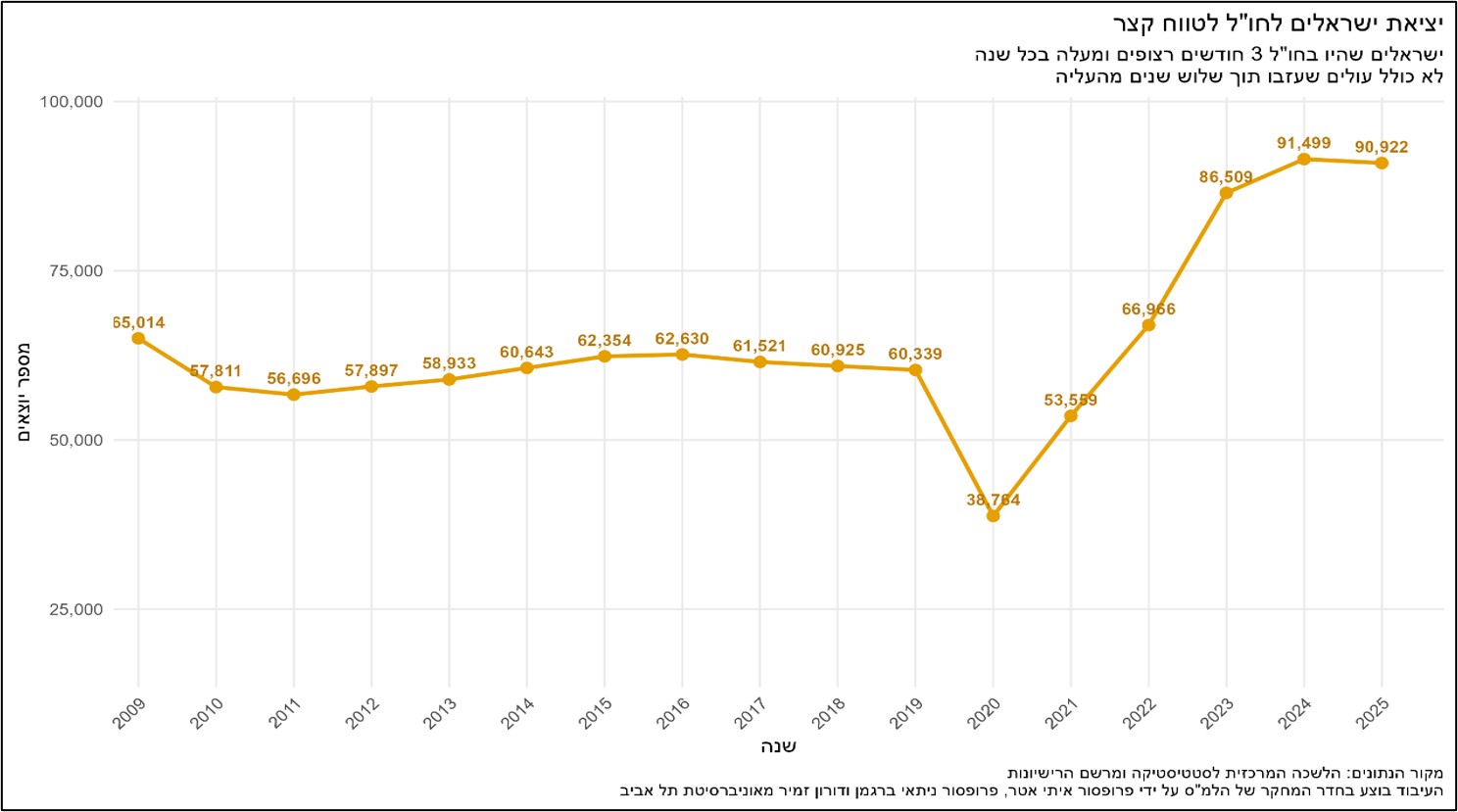
Number of Israelis leaving Israel for three consecutive months each year between 2009 and 2025
¹ To exclude immigrants who lived in Israel only briefly before leaving, Israelis are defined as Israeli citizens who had lived in Israel for at least three years prior to departure.
A New Measure for Tracking Emigration
The researchers explain that in their previous publication on emigration from Israel, released in February 2026, they relied on the standard measure of remaining outside Israel for 12 months or longer. Because official data based on that measure will only become available for 2025 at the beginning of 2027, the current study instead examines Israelis who remained abroad for at least three consecutive months.
According to the researchers:
“In our previous publications on emigration from Israel (February 2026), we relied on the standard measure: remaining outside of Israel for 12 months or longer. For 2025, such a measure will only become available at the beginning of 2027. Thus, to identify emigration trends now rather than wait until 2027, we present data on emigration from Israel based on a measure of leaving Israel for at least 3 months.”
To evaluate whether this shorter measure provides a reliable indication of longer-term emigration, the researchers compared the number of Israelis who remained abroad for at least three consecutive months with those who stayed abroad for 12 months or longer.

Number of Israelis leaving Israel for at least three consecutive months and for a period of 12 months
The comparison revealed a very strong correlation (0.96) between the two measures. Based on this relationship, the researchers estimate that between 45,000 and 50,000 Israelis are likely to have remained abroad for 12 months or longer during 2025, assuming the historical relationship between the two measures continues to hold.
The researchers conclude that the wave of emigration that began in 2023 continued through 2025, remaining at historically high levels.
Prof. Ater says:
“In 2025 we continue to see very troubling numbers of Israelis leaving the country for a significant period of time, adding to the 2023-24 wave of emigration. Taken by themselves, these figures do not yet pose a risk to Israel’s resilience. However, looking ahead—and unless there is a change—there is growing concern that rising emigration from Israel might jeopardize the country’s future security and economy.”
Why Monitor Emigration Trends?
The researchers note that emigration has long been part of Israel’s public discourse, including debates surrounding “brain drain” and broader discussions about Israelis leaving the country. They write that public attention to the issue increased following the November 2022 elections, the debate surrounding the government’s proposed judicial overhaul, and later intensified after the October 7 war.
According to the researchers, timely migration data are important for informing public policy and improving understanding of the phenomenon and its possible implications for Israel’s economy and society.
They also note that despite the importance of the topic, public discussions often rely on delayed or incomplete data. To address this gap, the current study combines CBS migration records with additional information on emigrants’ characteristics, including higher education data from the Council for Higher Education, professional licensing records from the Ministry of Health, and income and tax data from the Israel Tax Authority.
A Shift from Previous Migration Patterns
The researchers found that migration patterns changed significantly beginning in 2023.
After many years of relatively stable migration balances, nearly 270,000 Israelis left the country for at least three consecutive months between 2023 and 2025, averaging approximately 90,000 departures per year. During the decade between 2010 and 2019, the comparable annual figure was approximately 60,000.
The researchers also refer to findings from their previous publication, which identified increased emigration among physicians, PhD holders, engineers, and individuals with academic degrees and/or relatively high incomes.
International Context
The researchers emphasize that emigration of highly skilled populations is not unique to Israel. They cite countries including Greece, Hungary, Venezuela, Argentina, South Africa, and Lebanon as examples of nations that have experienced substantial emigration among highly educated or economically strong populations.
However, they argue that Israel’s economy may be particularly sensitive to such trends because it relies heavily on high-quality human capital, especially in high-tech, advanced healthcare, academia, and other knowledge-intensive sectors.
According to the researchers, these sectors depend on relatively small numbers of highly trained professionals whose departure could have disproportionate economic consequences.
Looking Ahead
The researchers stress that current emigration levels do not, by themselves, constitute a threat to the Israeli economy.
Instead, they argue that the primary concern is the disruption of the long-standing migration balance and the possibility that emigration could continue to rise. They suggest that additional political, economic, or security-related shocks could encourage further departures, potentially creating a feedback effect in which rising emigration encourages additional people to leave.
According to the researchers, if emigration were to exceed a certain threshold, reversing the trend could become extremely difficult, with broader macroeconomic consequences.
Definition of an Emigrant (Three-Month Measure)
For the purposes of this study, an Israeli is defined as an emigrant if the following conditions are met:
- Remaining outside Israel for at least three consecutive months from the date of departure.
- For new immigrants: having lived in Israel for at least three years before departure, in addition to the first condition.
For comparison with the standard measure used in the researchers’ previous publications, an additional criterion applies:
- Remaining outside Israel for more than 270 days during the first year following departure.