

 https://www.freunde-tau.org/wp-content/uploads/tel-aviv-580.jpg
Among the conference participants were public leaders, policymakers shaping the Israeli agenda, and U.S. Ambassador to Israel Mike Huckabee.
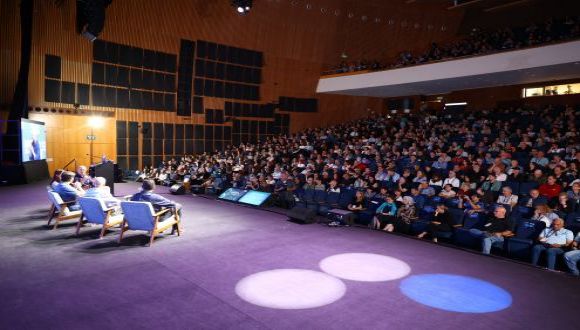
Against the backdrop of a dramatic year in which the boundaries of conflict, power, and democracy are being redefined — and with one of the most consequential elections in Israel’s history already on the horizon — Tel Aviv University hosted today (May 12, 2026) the Tel Aviv Conference: The Future of Israel, in collaboration with the Kadar Foundation.
The conference, which examined the geopolitical transformations taking place across the Middle East alongside the current state and future of Israeli democracy, drew a large and diverse audience. Participants came to engage in open public discourse and explore the research-based insights and multidisciplinary perspectives offered by Tel Aviv University scholars and experts.
Among the speakers were former President of the Supreme Court Prof. Aharon Barak, U.S. Ambassador to Israel Mike Huckabee, TAU President Prof. Ariel Porat, Tel Aviv–Jaffa Mayor Ron Huldai, former Foreign Minister Tzipi Livni, Minister of Diaspora Affairs and Combating Antisemitism Amichai Chikli, former Israeli Air Force Commander Amikam Norkin, former Deputy Head of the Mossad Udi Levy, Chairman of the National Economic Council Prof. Avi Simhon, Democrats Party Chairman Yair Golan, Ra’am Chairman MK Mansour Abbas, Dr. Shaul Arieli, and many others.
“The law must remain a place where truth is simply truth” – Prof. Ariel Porat
TAU President Prof. Ariel Porat opened the 2026 Tel Aviv Conference with remarks on the role of Israel’s Supreme Court at a time of growing political and social polarization.
Porat argued that the Court must rule solely according to the law, even in highly sensitive cases and despite public pressure or threats of noncompliance from government officials.
“Blackmail is blackmail is blackmail,” Porat said, referring to suggestions that Supreme Court rulings could be ignored. “If you surrender to it once, more threats will follow.”
He warned that avoiding legal decisions out of fear of political consequences or constitutional crises could ultimately damage both the judicial system and Israeli democracy itself.
Porat also cautioned against allowing strategic considerations to replace the principles of the rule of law, emphasizing that public trust in democratic institutions depends on the Court’s independence.
“We all, regardless of our political views, should have an interest in a court that rules according to the law and according to the law alone,” he said.
He concluded with a broader reflection on the role of the legal system in an increasingly polarized public sphere:
“In a reality where everything becomes strategy, the law must remain a place where truth is simply truth. Only this way can we build trust. Only this way can we build a future.”
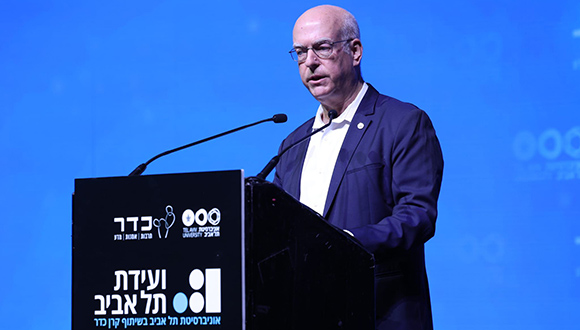
Prof. Ariel Porat, Photo credit: Israel Hadari
“This is a city where children learn not only how to solve an equation, but also why the equation exists in the first place”- Ron Huldai
Ron Huldai, Mayor of Tel Aviv–Jaffa, rejected attempts in his conference remarks to portray the city as privileged or disconnected, arguing that “Tel Aviv–Jaffa is an asset. Perhaps it is the greatest achievement of Herzlian Zionism.”
Huldai claimed that the gaps exposed during the war between the functioning of the municipality and that of the government stem from a deeper value system — one in which critical thinking is seen as essential rather than threatening.
“This is a city where children learn not only how to solve an equation, but also why the equation exists in the first place,” he said, directly linking the city’s liberal education system to its economic resilience and ability to function under extreme circumstances.
According to Huldai, Tel Aviv demonstrates that freedom is a source of strength, and that the city’s power lies in a community “that is not afraid of complexity.”
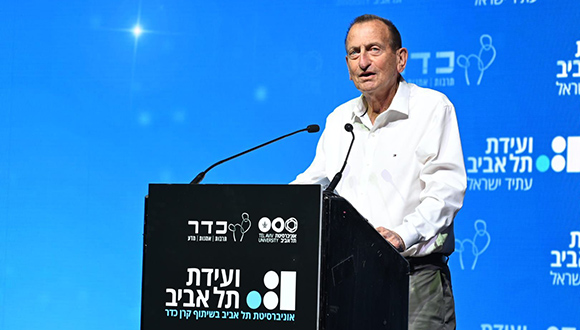
Ron Huldai, Photo credit: Israel Hadari
“The world should thank Israel, not condemn it”- Mike Huckabee
U.S. Ambassador to Israel Mike Huckabee received enthusiastic applause from the audience as he framed the regional conflict through the lens of Iran’s influence across the Middle East.
Referring to U.S. policy on Iran, Huckabee stressed that the American position remains firm and unchanged.
“The President was very explicitly clear from the beginning and throughout. He hasn’t changed even to this moment, and that is that Iran will never have a nuclear weapon,” Huckabee said.
The ambassador described Iran as the driving force behind multiple fronts of conflict facing Israel today.
“Keep in mind that every front of conflict that Israel faces, whether it’s Hamas, the Houthis, or Hezbollah — all of those ‘dishes’ of hatred and terrorism came out of the same kitchen, from Tehran.”
He also warned that Iran’s ambitions extend far beyond Israel.
“Israel is the appetizer, but America has always been the entrée,” Huckabee said. “It was always a matter of, if we can get past Israel, then ultimately we’ll set our sights on America.”
Alongside his security analysis, Huckabee expressed hope for a different future for the Iranian people after the current regime.
“I would hope that someday all that they were could be restored again,” he said, describing pre-1979 Iran as “a world leader in medicine, education, fashion, music, art, architecture — an amazing culture and an amazing people.”
Addressing the possibility of renewed fighting in the region, Huckabee remained cautious.
“We’d all love to see the war come to an end. I think it’s safe to say we’re in a ceasefire, but it’s hard to declare that it’s all over.”
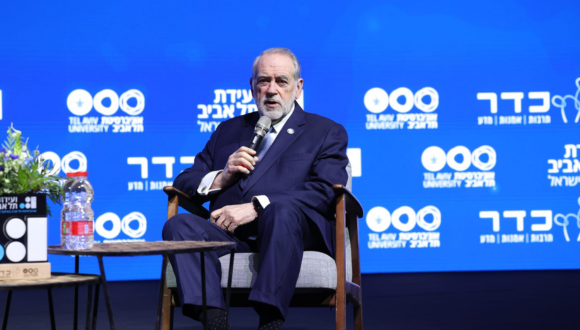
U.S. Ambassador to Israel Mike Huckabee, Photo credit: Chen Galili and Israel Hadari
“One thing gives me hope — the elections”- Prof. Aharon Barak
Former President of Israel’s Supreme Court, Prof. Aharon Barak, addressed a series of pressing legal and public issues currently at the center of Israeli discourse, including the proceedings against Israel in The Hague, Prime Minister Benjamin Netanyahu’s trial, the role of the Attorney General, and the future of the judicial system.
Barak emphasized that his decision to represent Israel in The Hague stemmed from a profound moral obligation, making a clear distinction between defending the government and defending the state itself.
“I went there not to defend the government or the Prime Minister, but to defend the State of Israel,” he said. “What Israel did in Gaza is not genocide. As a Holocaust survivor, who was himself a victim of genocide, I wanted to defend my country, which is accused of this.”
In his remarks, Barak also addressed the Prime Minister’s criticism of the judicial system, arguing that Netanyahu’s shift in attitude stems directly from his ongoing trial.
“He always supported the court system, and the change in his attitude stems from the trial against him,” Barak stated.
At the same time, Barak acknowledged the need for reforms within Israel’s judicial system, while warning against growing polarization and the collapse of dialogue within Israeli society.
“What characterizes the polarization today is the absence of dialogue; every group has its own monologue,” he said.
Asked what still gives him hope in light of Israel’s internal and external challenges, Barak concluded with a brief but pointed answer:
“One thing gives me hope — the elections.”
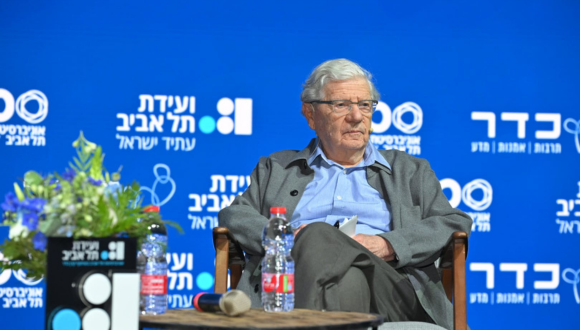
Prof. Aharon Barak, Photo credit: Israel Hadari
“We must choose between separation and annexation”- Yair Golan
Chairman of The Democrats party, Major General (res.) Yair Golan, delivered sharp criticism of the government’s conduct, focusing on the proposed appointment of Roman Gofman as Head of the Mossad, the future of the Israeli opposition, the campaign against Iran, and the Israeli-Palestinian conflict.
Referring to the reported appointment of Roman Gofman as Head of the Mossad, Golan claimed the decision was politically motivated.
“We all understand that the only reason for Gofman’s appointment is that Netanyahu wants the Mossad to be headed by someone who will conceal evidence in the Qatari affair,” Golan said.
While emphasizing that Gofman is “an excellent combat commander” and “a worthy military officer,” Golan argued that “the main problem is not Roman Gofman, but the person who appointed him – Benjamin Netanyahu.”
Addressing the upcoming elections, Golan framed the political struggle as a clash between democratic and anti-democratic values.
“These elections are between honest and corrupt people, between those who serve and those who evade service,” he stated. “We must rebuild the bloc that once had 56 seats in the Knesset and instill a winning mindset in our constituents.”
Golan also criticized what he described as the misuse of the concept of unity in Israeli politics.
“The word ‘unity’ has been abused,” he said. “Before talking about unity, we need to talk about values and liberal ideology.”
Turning to the Israeli-Palestinian conflict, Golan warned that Israel would ultimately have to make a historic decision.
“Sooner or later we will have to choose between separation and annexation,” he said. “We must ask ourselves a critical question: are we headed toward annexing 5 million Palestinians into our midst, which would mean the destruction of the State of Israel?”
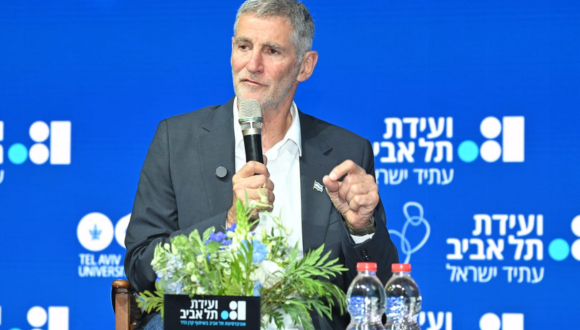
Yair Golan, Photo credit: Israel Hadari
“A leader is measured by the way they end a war — and here, the threat has not yet been removed”- Gadi Eisenkot
Chairman of the “Yashar!” party and former IDF Chief of Staff Gadi Eisenkot sharply criticized Israel’s political leadership, arguing that Prime Minister Benjamin Netanyahu failed the ultimate test of leadership — the ability to translate military achievements into strategic victory.
Eisenkot explained that his resignation from the government stemmed from the realization that he and Benny Gantz had become “fig leaves” for decisions that were later reversed under extremist political pressure.
“The cabinet failed to capitalize on the outcomes of the war in order to achieve its objectives, and that is a complete failure,” he said.
Referring to the Iranian threat, Eisenkot acknowledged Israel’s military achievements but stressed that the central goals — foremost among them dismantling Iran’s nuclear program and removing the missile threat — have not yet been achieved.
“A leader is measured by the way they end a war — and here, the threat has not yet been removed,” he stated.
On domestic Israeli issues, Eisenkot presented a firm position calling for full adoption of the values outlined in Israel’s Declaration of Independence and mandatory national service across all sectors of society as conditions for any future coalition.
He warned against the collapse of the “people’s army” model and called on the centrist camp to unite in order to secure a decisive electoral victory.
In emotional personal remarks, Eisenkot spoke about his late son Gal, who was killed in combat in Gaza and whom he described as representing an entire generation of sacrifice and service.
“We must prove ourselves worthy of the more than 2,000 fallen soldiers who gave their lives so there could be a better country here,” he said, adding that this commitment is the central driving force behind his public activity and his calls for deep reforms regarding Arab society and the fight against rising crime.
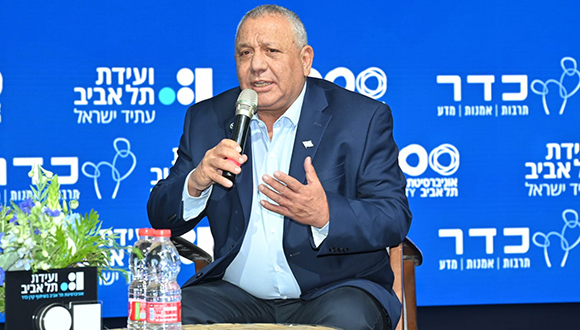
Gadi Eisenkot, Photo credit: Israel Hadari
Polarization, Social Cohesion, and Arab Citizens’ Support for Civil Service
Researchers from Tel Aviv University also presented findings from several new studies examining social cohesion, political polarization, and changing attitudes within Arab society in Israel.
Dr. Nimrod Nir, CEO of the Agam Institute, and Asa Shapira, Head of the Marketing and Advertising Track at TAU’s Department of Communication and researcher at the Agam Institute, presented findings from the Social Cohesion Trends Study and the National Polarization Index. According to their research, Israel’s political and social polarization has reached a severe level and is approaching a point that could potentially lead to civil conflict.
As part of the study, conducted ahead of the elections, 6% of respondents said they support the use of violence to achieve an important goal, while 11% stated they would support any action — including violence — if it were intended to “save democracy.”
The researchers warned: “Israel is no longer just a divided society. It is approaching a zone in which socio-political polarization could evolve into civil conflict.”
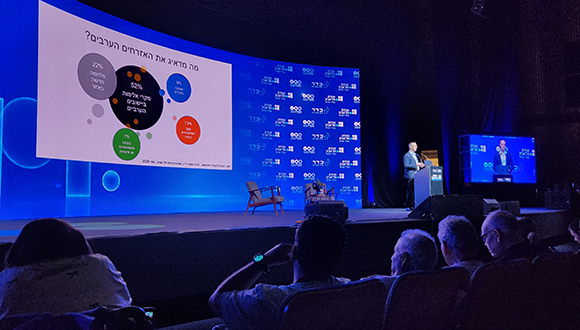
Dr. Arik Rudnitzky of the Konrad Adenauer Program for Jewish-Arab Cooperation at the Moshe Dayan Center at Tel Aviv University presented findings indicating a significant shift in attitudes within Arab society in Israel.
According to the study, approximately 75% of respondents support non-military civil service, alongside a strong desire for political integration: more than 77% support the inclusion of an Arab party in the government.
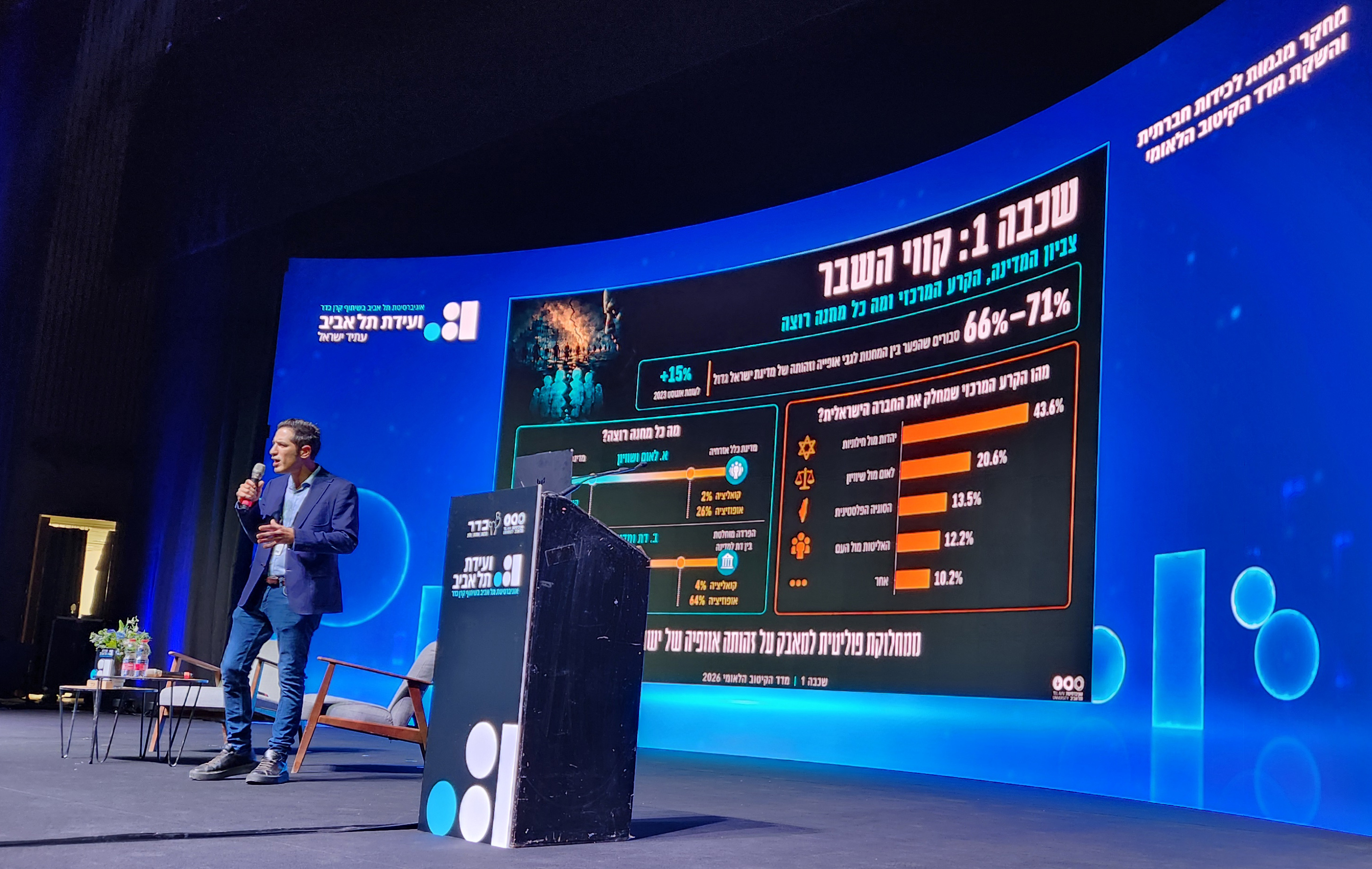
Dr. Nimrod Nir, Photo credit: Israel Hadari
While only 8% of respondents ranked the Palestinian issue as their top concern, an overwhelming majority (71%) identified crime and violence within Arab society as the most urgent issue on their agenda.
“Arab citizens are presenting a roadmap for rebuilding Israeli society through integration and influence,” explained Dr. Rudnitzky.
The study also points to unprecedented political potential ahead of the elections: if a united Arab joint list is established, voter turnout in Arab society could rise to 67%, potentially translating into 16 Knesset seats.
At the same time, the findings indicate a strengthening Israeli civic identity, with more than half of respondents (53%) reporting a strong sense of belonging to the state. However, the researchers emphasized that feelings of personal security remain extremely low due to internal violence and fears related to war.
“Support for integration did not decline after the war,” Rudnitzky concluded, “but Arab society expects an urgent governmental response to issues of crime and protection.”
Dr. Arik Rudnitzky, Photo credit: Israel Hadari
“We are not in a position of saying ‘no and no,’ but rather ‘yes — and what can be done’.- Mansour Abbas
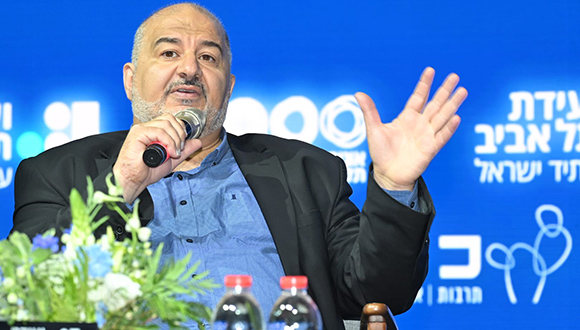
Following the presentation of the research findings, Ra’am Chairman MK Mansour Abbas outlined a pragmatic approach aimed at translating the Arab public’s desire for political and civic influence into concrete action.
Abbas revealed that his party is advancing a dedicated framework for civil service intended to support tens of thousands of young Arab citizens entering the workforce.
“We are not in a position of saying ‘no and no,’ but rather ‘yes — and what can be done,’” Abbas said, emphasizing that civil service serves the interests of individuals, communities, and Israeli society as a whole.
On the political level, Abbas made clear that Ra’am seeks to replace the current government and views Arab-Jewish partnership as a central issue in the upcoming elections. He also expressed support for establishing a pluralistic joint list aimed at maximizing Arab political influence, while stressing the importance of responsibility and partnership.
Referring to tensions following October 7, Abbas said that Arab society had demonstrated restraint and maturity despite experiencing “double pain” during the war.
“The proper process, one that aligns with Israel’s democratic identity, is that the presence of an Arab party in the coalition can only contribute,” Abbas said.
Mansour Abbas, Photo credit: Israel Hadari