

 https://www.freunde-tau.org/wp-content/uploads/ChatGPT-Image-Aug-3-2026-02_39_21-PM.jpg
TAU biomedical engineering students put people at the center of their innovations
When Mooshi was born, she entered the world with a challenge that would affect much of her childhood: she had only three fingers on each hand.
Mooshi loves making art and using her imagination. But the tools to do that, though simple for most children to use, can be a frustrating obstacle for her. Without a thumb to help grip and control scissors, for example, an activity that came naturally to other children became a complex engineering problem waiting to be solved.
The question posed to a group of Tel Aviv University biomedical engineering students was simple: How can they help Mooshi do what she loves?
This encapsulates the philosophy behind TAU’s “Engineering Design” course, an innovative program in the Iby and Aladar Fleischman Faculty of Engineering. Now in its 11th semester in the School of Biomedical Engineering, in collaboration with TAU Impact (Mitchabrim Plus), and partners in the community, the course challenges students to exercise what they learn in the classroom by developing solutions for people who need them most.
The course not only creates value for those who need help; it also prepares students for a workforce that increasingly requires practical problem-solving skills, creativity, teamwork, and the ability to apply engineering principles to real-life situations.
“Every great engineer begins with a deep understanding of the problem,” says Prof. Rani Gilad-Bachrach of the Fleischman Faculty of Engineering and the lead instructor of the course.
“The students learn to study problems through direct engagement with people; they learn how to collaborate and be creative about solutions; and they discover how capable they truly are. At the same time, they create real value for the people and organizations we work with — making it a win-win.”
Engineering with a Human Purpose
The course is based on a powerful idea: “Solve one problem for one person.”
Each semester, approximately 35 students develop engineering solutions addressing challenges in rehabilitation, accessibility, and quality of life. The projects are created in collaboration with community partners, including Beit Sefer Onn in Tel Aviv, a specialized educational and rehabilitation center serving children and young adults with cerebral palsy and complex physical disabilities.
The collaboration allows students to experience engineering as it exists in the real world, where the user’s needs, limitations, feedback, and daily experiences must guide every decision.
When tackling Mooshi’s challenge, the process required experimentation, failed prototypes, adjustments, and a willingness to listen. Eventually, the students developed a small modification to traditional scissors that allows Mooshi to open and close them using the natural movement of her hand, giving her the independence to create on her own.

As one student summed it up: “Technology should be adapted to the user, rather than forcing the user to adapt to the technology.”
Helping Children With Disabilities Walk, Eat, and Speak
Throughout the semester, students worked on a wide range of projects designed to make everyday activities more accessible:
One team developed a voice-activated system for Itamar, a five-year-old boy who is unable to use his hands effectively. Although Itamar is highly verbal and communicates well, using a computer independently was difficult because clicking a mouse required movements he could not perform. The students created a system allowing him to replace the mouse click with a voice command – giving him greater independence.
Another group focused on helping children with mobility challenges walk more safely. After studying the difficulties faced by young kids with physical disabilities, they created a modular support device with customizable straps that improves stability while walking. Testing with children such as Michael demonstrated how a thoughtful adaptation of existing materials could make a meaningful difference.
For Nevo, a 13-year-old boy who faces challenges related to eating safely, students designed a customized spoon. By carefully considering the angle, length, and depth of the spoon, they created a tool better suited to his needs — while learning a crucial engineering lesson: safety must always come first.
Other projects included:
- A bicycle adaptation that makes it easier to grip the handlebar.
- A device that helps children keep their feet securely positioned on bicycle pedals.
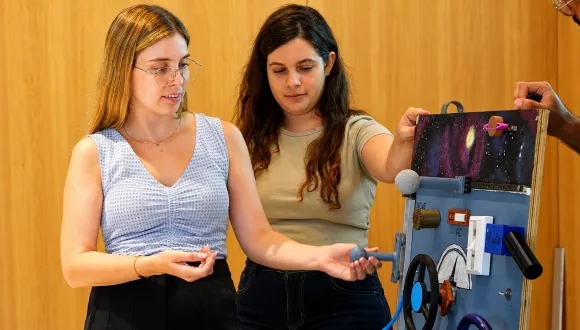
- A fine-motor skills therapy board inspired by space rockets, designed to motivate children to practice pulling, pushing, pressing, and opening movements through play.
- A digital system for Beit Sefer Onn that organizes information about children, therapists, and treatment groups, making administrative processes more efficient and reducing errors.

Learning That Leaves an Impact
A pair of scissors may seem like a small thing. But for one little girl with three fingers, it became a symbol of what engineering can truly achieve: turning obstacles into possibilities.
“We’re so happy to have this connection with TAU students,” said Tamar, a representative from participating school Beit Sefer Onn. “In a short time, they succeeded in creating solutions that we are already using.”
The vision behind the initiative is to expand this model throughout the Faculty of Engineering, enabling approximately 1,000 students to participate in socially impactful engineering projects every year.
The goal is ambitious: that every engineering student at Tel Aviv University will participate in at least one project during their studies that applies engineering skills to address a challenge of someone in our community. TAU believes this is the humanistic future of engineering: creating solutions that help everyone participate fully in the world around them.