

 https://www.freunde-tau.org/wp-content/uploads/Joel-Mokyr-on-campus.jpg
The 2025 Nobel Prize in Economic Sciences laureate visited campus for three days of lectures, discussions, and special events celebrating his achievements and longstanding ties to the University.
This week, Tel Aviv University welcomed back Prof. Joel Mokyr, winner of the 2025 Nobel Prize in Economic Sciences and Visiting Professor at TAU’s Eitan Berglas School of Economics, for a three-day campus visit celebrating both his academic achievements and his longstanding connection to the university.
The three-day visit included an interdisciplinary discussion on economic history, a public lecture titled “What Drives Economic Growth?”, a ceremony dedicating the Economics Student Plaza in his honor, participation in a conference at the Porter School of Environmental and Earth Sciences, and a special reunion with his former high school classmates, who gathered on campus to celebrate his Nobel Prize.
Prof. Mokyr, an Israeli-American economic historian and professor at Northwestern University, received the 2025 Nobel Prize in Economic Sciences for his pioneering research on innovation, technological change, and the forces that drive long-term economic growth. His work has fundamentally reshaped the understanding of how scientific knowledge, institutions, and ideas contribute to prosperity over time.
Exploring the Origins of Economic Growth
One of the highlights of the visit was a public lecture, hosted by Tel Aviv University President Prof. Ariel Porat and Vice President for International Affairs Prof. Milette Shamir, which brought together students, faculty members, and members of the public to explore one of the central questions that has shaped Prof. Mokyr’s career: What enables societies to innovate and grow over the long term?
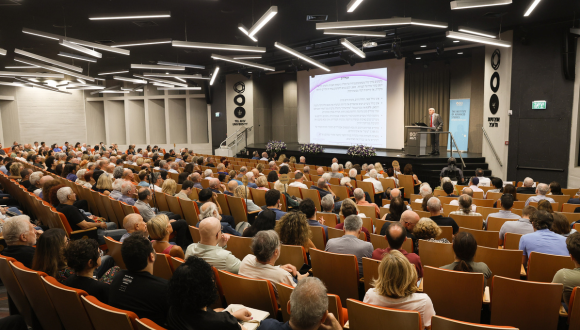
Prof. Joel Mokyr delivering his lecture at Bar-Shira Hall during his visit to Tel Aviv University
Prof. Mokyr began teaching at Northwestern University in 1974 and was elected to the American Academy of Arts and Sciences in 1996. Throughout his career, he has served as President of the Economic History Association and developed the concept of the Industrial Enlightenment, which links ideas from the Enlightenment to the processes that drove the Industrial Revolution.
His books include A Culture of Growth: The Origins of the Modern Economy (2016) and Two Paths to Prosperity: Culture and Institutions in Europe and China (2025).
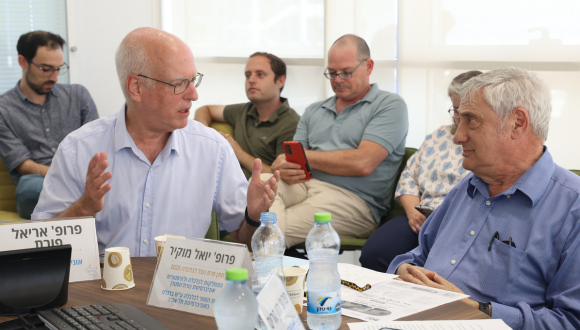
The visit also included an interdisciplinary discussion on economic history with researchers from across the University and Prof. Mokyr’s participation in a conference at the Porter School of Environmental and Earth Sciences. On Monday, classmates from his high school years gathered on campus for a special reunion celebrating his Nobel Prize, marking another memorable moment during his visit.
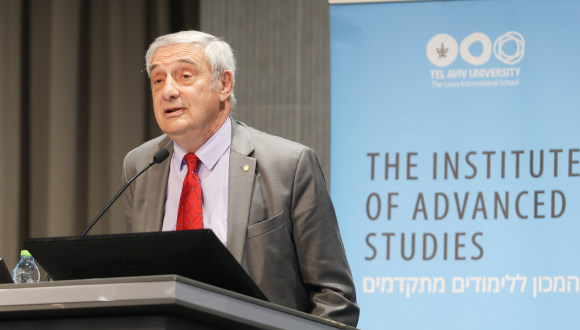
Prof. Joel Mokyr
Honoring a Longstanding Member of the TAU Community
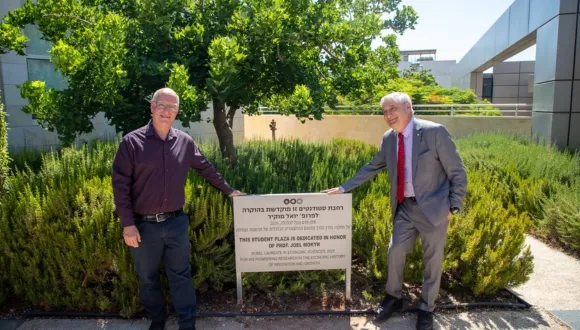
As part of the visit, Tel Aviv University dedicated its Economics Student Plaza in honor of Prof. Mokyr, recognizing both his groundbreaking scholarship and his many years of teaching and mentoring students at the Eitan Berglas School of Economics.
Prof. Joel Mokyr with Tel Aviv University President Prof. Ariel Porat
Reflecting on his connection to Israel and Tel Aviv University, Prof. Mokyr said:
“No matter where you live, Israel remains stuck deep in your soul. I especially love teaching Israeli students—they are always highly involved and ready to share their ideas. I can’t wait for what comes next…I’m only getting started.”
On AI, Innovation, and the Future of Universities
Prof. Mokyr’s research has long explored how the creation and dissemination of what he calls “useful knowledge” helped drive the Industrial Revolution and laid the foundations for modern economic growth. During his visit, we asked him how he sees these ideas applying to one of today’s most transformative technologies: artificial intelligence.
If innovation depends not only on new inventions but also on the spread of knowledge, what role might AI play? Could it expand this body of knowledge, or reshape the conditions that make innovation possible?
“My sense it could go either way,” Prof. Mokyr said.
“AI clearly will expand the body of knowledge and make it even more accessible. Yet if the entire world will use two or three sources of AI, say ChatGPT and Claude and Gemini, then we may all be bleating the same tones.”
At the same time, he noted that if the entire world were to rely on only a handful of AI systems, diversity of thought could suffer. Drawing on lessons from economic history, however, he believes competition will continue to challenge dominant technologies and encourage new ideas.
“I expect the number of companies providing AI and other sources will expand, and they may use very different algorithms and ways to process information, and in that world they can avoid the loss of diversity—and could even expand it. It’s hard to predict, but the past teaches us that monopolies are always contestable and in the long run even IBM and Google and Amazon have had to face new entrants and competition—the essence of creative destruction.”
He concluded:
“AI is a malleable tool and I would not be surprised if it actually led to MORE intellectual diversity.”
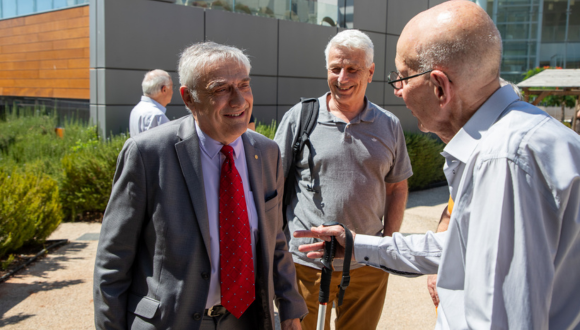
Prof. Joel Mokyr
Prof. Mokyr also reflected on the role universities play in sustaining the international exchange of ideas at a time of increasing political polarization and geopolitical competition.
” Universities are a major pillar of the global intellectual community—they make an explicit effort to promote international connections, of students, faculty, and even staff.”
He added:
“The campuses are full of foreign students, postdocs, academic visitors. They run seminars and conferences that attract scholars from all over. Many Universities have overseas campus and have ‘semester abroad’ and similar program, fostering cosmopolitan attitudes and supporting worldwide connections. In short, they are one of the main drivers of the global intellectual community—how could they not?”