

 https://www.freunde-tau.org/wp-content/uploads/julie-elie-580_1.jpg
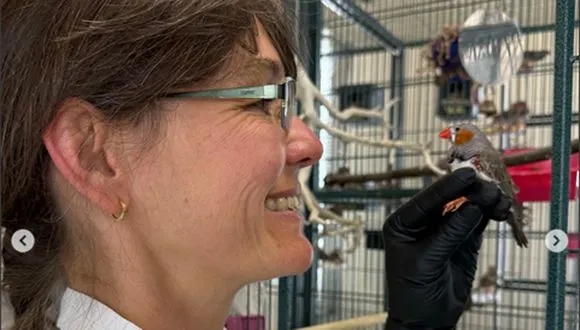
The 2026 Coller Dolittle Prize was awarded to Dr. Julie E. Elie for research showing that zebra finches classify calls by meaning rather than sound.
The Jeremy Coller Foundation and Tel Aviv University have announced the winner of the 2026 Coller Dolittle Challenge for Two-Way Interspecies Communication. This year’s US$100,000 prize was awarded to Dr. Julie E. Elie, of the Theunissen Lab at the University of California, Berkeley, for her discovery that zebra finches classify their calls according to meaning more so than acoustics.
Building a Dictionary of Bird Calls
Using AI machine learning and detailed observations of animal behavior, Dr. Julie Elie and her team investigated the acoustic features of zebra finches’ vocalizations and created a “dictionary” classifying zebra finches’ vocalizations into 11 categories or call-types, with meanings such as aggression, hunger or bonding. Elie took her research one step further, carrying out an experiment that tested whether the birds agreed with her classification. She trained zebra finches to press buttons which played her categorized call-types, each day rewarding only one of the call-types with seeds. The birds rapidly learned which call-type was being rewarded, waiting for their reward at the end of the playback, and interrupted non-rewarded call-types.
The Discovery Came from the Birds’ Mistakes
But the truly remarkable scientific advancement was discovered after the categorization exercise, when Elie and her team investigated the errors that birds made when seeking the rewarded call-type. Zebra finches made classification mistakes on calls with shared meaning that could not be explained by how similar-sounding these call-types were. For instance, the birds mistook long-distance contact calls and short-distance contact calls, which are acoustically very different. But, they never mistook a short contact call with a short alarm call, which have very similar acoustic patterns but entirely distinct meanings. As such, the study reveals that call perception elicits a mental imagery of the meaning of call-types, rather than triggering a reflexive response.
AI Brings Scientists Closer to Animal Communication
The prize was presented during an event on 25th June with four shortlisted teams of researchers from the US, France and Switzerland presenting their remarkable discoveries on communication with African striped mice, chimpanzees and bonobos. AI tools were central to the finalists’ studies, enabling them to analyze larger data sets at greater speed, and to decode bioacoustic patterns which are inaudible to human hearing.
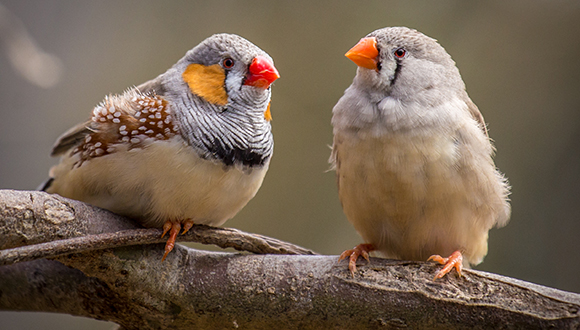
A pair of zebra finches
Dr. Julie Elie said:
“Our research shows that exciting scientific discoveries come from mistakes. It’s been a fascinating collaborative exercise to ask the zebra finches questions about their vocalizations. The fact that, sometimes, the birds get the classification of their own calls wrong has enabled us to gain huge insight into their perceptions and mental imagery.
“But, there is so much more to be done. Beyond developing the right algorithm to interpret animal vocalizations, we must coordinate the acoustic with the visual. I am excited for the development of robots to mimic the movements and posture of the species we’re interested in. But in the meantime, I’m delighted that I have been recognized by the Coller Dolittle Committee for our team’s contributions to the goal of two-way interspecies communication. I am really grateful to all the people that contributed to this project and to the Jeremy Coller Foundation for making this recognition possible.”
From Animal “Words” to Animal “Sentences”
Professor Yossi Yovel, Tel Aviv University and Chair of the Coller Dolittle Challenge, said: “This year’s finalists have raised the scientific bar of the Coller Dolittle Challenge even further. We have seen a clear transition from studying individual animal “words” to the study of “sentences”. Dr. Julie Elie’s research excelled in all domains. Her study has gone beyond decoding zebra finch’s communication and has begun to answer whether these patterns identified by scientists are actually relevant and meaningful to the birds. On this trajectory, we are accelerating at pace towards two-way interspecies communication.”
Jeremy Coller said: “Congratulations to Dr. Julie Elie, a well-deserved winner of this year’s Prize. From primates to rodents, from jungles to deserts, down on the ground and up in the sky, today’s finalists are all pushing the frontiers of animal communication. While the ultimate goal of achieving genuine two-way communication remains tantalizingly out of reach, scientists are bringing us all one step closer to what I am convinced is now inevitable.
AI is accelerating so fast, I have absolute conviction we’ll crack the code by 2030 – a breakthrough that will benefit humans and our fellow animals the world over and give a long overdue voice to the voiceless.”