

 https://www.freunde-tau.org/wp-content/uploads/adi-rahum580_0.jpeg
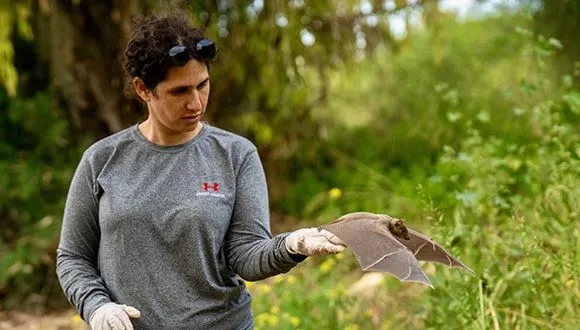
A new TAU study shows that early-life experiences — more than innate personality — shape how bats behave in the wild.
A new study from Tel Aviv University’s School of Zoology reveals that the environment in which a bat is raised during the first months of its life largely determines how it will behave in the wild, sometimes even more than its innate personality.
The study, led by doctoral student Adi Rachum from the laboratory of Prof. Yossi Yovel at the School of Zoology, Wise Faculty of Life Sciences, and the Sagol School of Neuroscience, was published in the journal eLife.
Growing Up in Two Different Worlds
The research investigated for the first time how early exposure to a variable and challenging environment affects the behavior of Egyptian fruit bats after they are released into the wild. The researchers raised 40 young bats in two completely different environments: one enriched and dynamic, in which the bats had to cope with new challenges every day in order to obtain food; and the other stable and unchanging. After a period of several months, their behavior in the wild was monitored using GPS devices that tracked their every flight.
The findings were clear and consistent: bats raised in the enriched environment exhibited much bolder and more exploratory behavior in the wild. They flew farther away from “home,” spent more time out foraging at night, and explored areas almost twice as large as those explored by the control group.
For example, bats raised in the enriched environment explored average foraging areas of approximately eight square kilometers, compared to only about three square kilometers among bats raised in the impoverished environment. The maximum distance they ventured from the colony was also notably greater — an average of about 1.3 kilometers versus only 0.8 kilometers in the comparison group. In addition, they spent an average of roughly four hours outside the colony each night, compared with less than three hours among bats in the control group.
Not Personality — Experience
To ensure that the differences did not stem from variations in the bats’ innate personality, the researchers assessed the young bats’ personality traits in the laboratory before they were exposed to the different environments. They found that these traits did not predict the bats’ behavior in the wild as adults. In other words, the bats’ innate disposition did not account for their later differences in behavior in the wild. Instead, the environment in which they were raised during their early life proved to be the decisive factor shaping how they behaved as adults.
Adi Rachum explains: “Fruit bats are animals with remarkable behavioral flexibility and learning capacity. We found that the early environment to which bats are exposed influences the way they explore the world.”
Prof. Yossi Yovel adds: “In previous studies, we identified behavioral differences between exploratory urban bats and more ‘conservative’ rural bats. The current findings may explain how these differences between the groups are formed.”

Prof. Yossi Yovel
*Prof. Yossi Yovel is a world-renowned Israeli researcher and a senior faculty member at the School of Zoology and the Sagol School of Neuroscience. He leads the field of neuroecology, which combines brain research and ecology to understand how animals make decisions and navigate in their natural environment. Considered a leading expert on bats, he studies their sonar system (echolocation), social communication, and remarkable navigation abilities.