

 https://www.freunde-tau.org/wp-content/uploads/gyss2026-1.jpeg
Connecting with Nobel and Turing Laureates at the Global Young Scientists Summit in Singapore
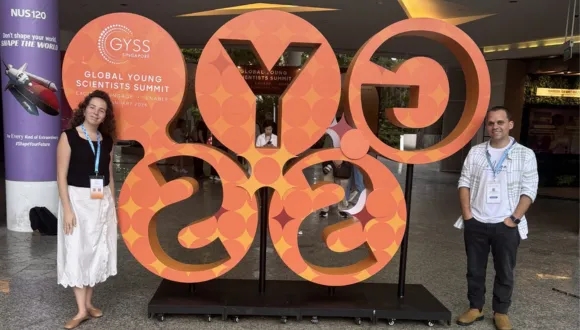
Each year, Tel Aviv University sends outstanding doctoral students to the Global Young Scientists Summit (GYSS) in Singapore, an interdisciplinary forum for emerging researchers worldwide. In 2026, Arielle Kaim from the Gray Faculty of Medical Sciences and Alon Itzkovitch from the Faculty of Life Sciences represented TAU.
Coming from very different research backgrounds — disaster response (Kaim) and neurobiological decision-making (Itzkovitch) — both found the Summit took them beyond their usual academic frameworks: explaining complex research to unfamiliar audiences, drawing unexpected links across disciplines, and engaging directly with award-winning scholars in candid, informal settings.
A Summit Built on Dialogue
Hosted by Singapore’s National Research Foundation, GYSS gives outstanding early-career scientists an opportunity to meet recipients of the Nobel Prize, Fields Medal, Millennium Technology Prize, and Turing Award. The programme combines plenary lectures, research seminars, panel discussions, and smaller interactive sessions that encourage direct dialogue between laureates and participants.
For both TAU students, the most meaningful moments often happened outside of the formal programme, echoing the summit’s theme of Excite, Engage, Enable.
“I think that the element that was most interactive and nice was sitting down at dinner and having just normal conversations with the Nobel Prize or Turing award winners.”—Arielle Kaim
“At the end of the day, the Nobel Prize winner is a person that undergoes the same challenges that we do as young researchers,” she reflects.
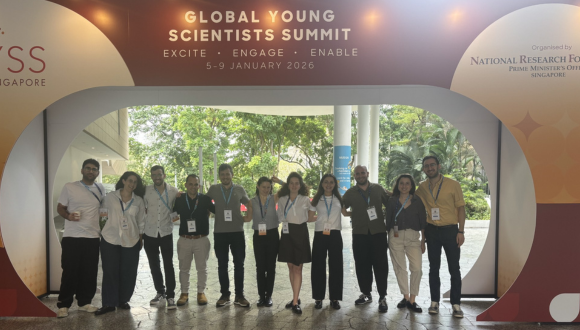
The Israeli delegation at the Global Young Scientitsts Summit 2026
For Itzkovitch, who had previously attended virtually in 2023, the in-person format highlighted what makes GYSS unique.
“The topics are very broad, which is very different from a regular scientific conference. But if you want to collaborate, if you want to communicate, if you want to hear new ideas, this is the place.”—Alon Itzkovitch
Alon Itzkovitch: How to Explain Your Research in Simple Terms
Itzkovitch also participated in the Summit’s poster session, presenting his work to audiences far from his usual academic circle.
A PhD candidate in Professor Tom Schonberg’s lab, Itzkovitch conducts multidisciplinary research at the intersection of biology, neuroscience, and decision science.
His work combines laboratory experiments, physiological signals, and computational analysis to better understand how subjective thermal perception conditions cognitive choices.
At GYSS, he had to translate these complex ideas for engineers, computer scientists, and researchers from entirely different fields.
“In regular conferences, I’m used to diving in and being much more specific than I had to be in the GYSS. It was like trying to explain to my father what I am doing.”
“Talking to the first person was a bit difficult, but then I understood that this is not the audience I’m used to and adapted,” Itzkovitch comments.
Arielle Kaim: How to Find Connections with Other Disciplines
Arielle is a PhD candidate in the Department of Emergency and Disaster Management of the School of Public Health, and her research is connected to real-world humanitarian response. She works with World Health Organization teams that deploy field hospitals during disasters and public health emergencies.
Her doctoral research focuses on developing a real-time evaluation tool to assess how effectively these field hospitals function in environments with limited infrastructure and unstable resources. She examines how teams adapt and how emergency response systems can be strengthened.
“It’s not research for the sake of theory, but research for the sake of enhancing disaster response.”
The tool has already been applied in real-time across multiple disaster medical full-scale simulations and deployments, including most recently in a field hospital setup in Israel during an ongoing war, and an upcoming mission related to flooding and cholera outbreaks in Mozambique.
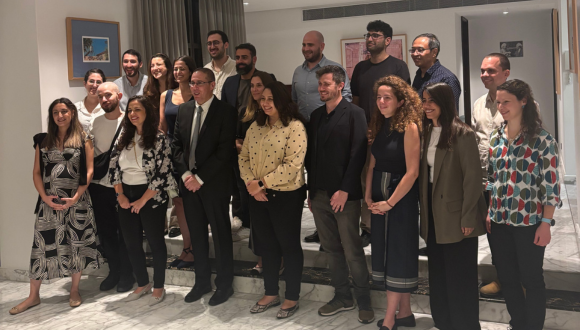
The Israeli delegation at the Global Young Scientitsts Summit 2026
At GYSS, Kaim found connections between her field and others, from water quality research to emerging technologies.
“It’s very interesting to engage with colleagues from different disciplines. I always find that no matter what anyone is working on, there are always linkages to emergency and disaster management.”
Kaim deliberately chose sessions outside her immediate field, such as panels on quantum computing and artificial intelligence, where Turing award recipient Prof Adi Shamir of the Weizmann Institute took part.
“They spoke about supercomputing versus the quantum era, how things are going to change going forward and where computing is taking us. It’s not my field, but interesting to expose yourself to.”
She also attended the session on Geopolitics to Genomics: Concurring Minds in a Multipolar World, where Professor Aaron Ciechanover, the Nobel laureate in Chemistry from the Technion Institute of Technology was among the panelists. The session explored the potential for collaborative science and shared innovation in the environment of rising complexity and competition.
Another Summit highlight was the session Breaking Barriers, Leading Change: Challenges in STEM, which focused on leadership, inclusion, and the evolving responsibilities of researchers.
Stronger Community Ties
Both students emphasize the value of the human connections they formed with international peers and in particular with fellow Israeli researchers.
“What I enjoyed the most was connecting with Israeli colleagues. We’re still in touch and we find how we can help each other and connect other colleagues with the ones that we met at GYSS.”—Arielle Kaim
Every evening, the Israeli participants went out to have dinner and explore the city together. They also visited the Israeli embassy in Singapore and will meet the Ambassador of Singapore to Israel.
Why Is the Summit Worth Participating in?
Kaim’s advice is to fully engage with the Israeli colleagues and with international researchers you might never meet otherwise
“Try to find points of connection, whether personal or professional, and just enjoy and take time to explore also.”—Arielle Kaim
Itzkovitch emphasizes the value of meeting leading scientists from different fields, and communicating with very different people.
“Participating in the summit is a great idea if you want to communicate and hear some new ideas that are far from what you do in your daily lab work.”—Alon Itzkovitch
And then, there is the city of Singapore itself, beautiful, modern, and very green.
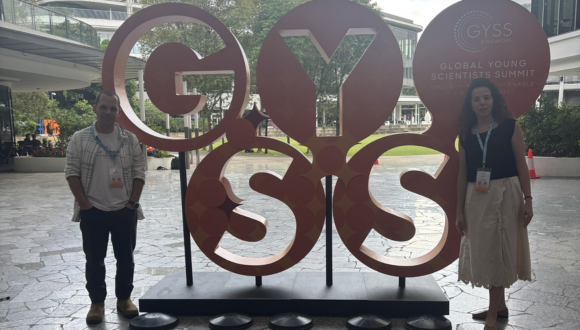
Alon Itzkovitch and Arielle Kaim at the GYSS-2026 in Singapore
“I was most shocked by the greenery of the city and how in such a vibrant city you can actually create something so green. It’s a city that’s living and breathing. It has a lot to offer,” says Kaim.
Both described Singapore as innovative and forward-looking, drawing parallels to Israel’s own culture of research and development.
With the support of the Lowy International School, Tel Aviv University’s doctoral researchers were able to represent TAU on a global stage and return with new insights and professional connections.