

 https://www.freunde-tau.org/wp-content/uploads/gorillas_580x330.jpg
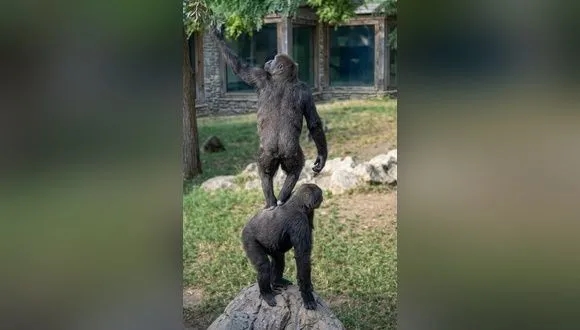
A new Tel Aviv University study documents how two female gorillas at the Ramat Gan Safari repeatedly worked together to reach food, forming a “living ladder” that offers new insights into cooperation among great apes.
When a leafy branch is out of reach, a helping hand or a steady back can make all the difference. Researchers from Tel Aviv University have documented two female western lowland gorillas forming a “living ladder”: one climbs onto the other’s back to reach vegetation that would otherwise be inaccessible.
The study was led by Michael Levitsky and Prof. Israel Hershkovitz of the Department of Anatomy and Anthropology at the Gray Faculty of Medical and Health Sciences and the Dan David Center for Human Evolution and Biohistory Research at Tel Aviv University. Published in the journal Primates, the study describes a rare example of spontaneous cooperation between adult gorillas, with a clear division of roles. Three different events documented at the Ramat Gan Safari in 2021, 2024, and 2025 involved the same half-sisters, Amelia and Lisha, each performing the same role every time: Lisha provided a stable platform, while Amelia climbed on her back and reached for branches. The observed behavior was spontaneous: neither gorilla had been trained to perform it.
How the Gorillas Built Their “Living Ladder”
The most extensively documented event came to light in September 2024, after keepers noticed the two females peacefully eating bark and leaves from a large branch that had previously been beyond their reach. To discover how they had obtained the food, staff reviewed security camera footage.
The footage revealed a coordinated sequence of actions. Amelia walked over and climbed onto a rock beneath a Peltophorum dubium tree. Lisha then joined her and stood firmly on all fours on the rock. Amelia climbed onto Lisha’s back, stood upright, and stretched upward to grasp and break off a branch approximately 4.5 meters above the ground. The combination of the rock, Lisha’s stable posture, and Amelia’s reach enabled her to access the branch. (An electric barrier around the tree trunk prevented them from climbing it directly).
Another video, from June 2025, revealed a particularly telling detail: Lisha approached Amelia and positioned herself with her back toward her, ready to support the climb. Amelia was not observed using force or attempting to move Lisha into position, and Lisha’s participation appeared voluntary. The researchers interpret this pattern as cooperation because the two gorillas’ actions depended on one another and appeared directed toward the same immediate goal: reaching the branch and bringing it down.
Cooperation Without Sharing or Close Social Bonds
This cooperation did not always lead to food sharing afterward. While keepers reported peaceful shared feeding following the 2024 event, in the sequence observed in 2025, Amelia alone ate the vegetation. This difference indicates that cooperating to obtain a resource and subsequent sharing are separate aspects of social behavior.
The partnership between Amelia and Lisha is particularly striking because the sisters do not usually spend much time together. They sleep in separate night quarters and rarely groom one another. Their behavior suggests that effective teamwork can occur even between animals that do not routinely display close social bonds.
The study, however, involves only two individuals and three documented events. The examined footage does not allow the researchers to determine whether the gorillas communicated through vocalizations or subtle gestures or planned their actions in advance. But regardless of these limitations, the recurring “living ladder” offers a fascinating glimpse into gorillas’ ability to coordinate their body movements, use features of their surroundings, and solve a problem together.
What the Safari’s Observations Reveal About Gorilla Intelligence
Yehonatan Samocha, Head of the Primate Section at the Ramat Gan Safari (Zoological Center Tel Aviv-Ramat Gan), explains: “At the Ramat Gan Safari we have observed and studied animal behaviors for years, closely following their relationships, social bonds, and fascinating capabilities. Particularly among great apes, including gorillas, we repeatedly encounter behaviors that demonstrate high intelligence, learning ability, problem-solving, complex communication, and cooperation.
“This is why we are so thrilled, though not necessarily surprised, by the cooperation between Amelia and Lisha. We are familiar with their abilities and understand how intelligent and curious they are, and how capable they are of learning from one another and working together. Sometimes, our surprise tells us more about our expectations of animals than their actual abilities. The study’s great importance lies in providing scientific documentation and analysis for observations and behaviors we encounter in our daily work, allowing us to enhance our knowledge of gorillas, their social world, and their cognitive abilities.”
What Can Gorilla Teamwork Teach Us About Human Evolution?
Prof. Israel Hershkovitz concludes: “Our observations reveal how two gorillas can join forces and assume complementary roles to solve a problem that neither can solve on her own. It is particularly intriguing that this cooperation recurs even though the two do not usually display much closeness, and even when the food is not shared between them afterward. These observations are important for understanding human evolution because they offer an explanation, albeit a partial one, for how we survived on the savanna – through social support and a high level of cooperation that can occur even without language or preplanning. Although the number of observations is small, they offer a window into gorillas’ ability to learn from experience, coordinate their actions, and draw on one another and their surroundings to achieve a shared goal.”
Michael Levitsky, who initiated and led the study, adds: “When I first watched the footage, it was clear to me that this was something extraordinary. What I find fascinating is that Lisha did more than simply serve as a ‘step’ for Amelia. She appeared to participate actively and willingly in solving the problem, approaching on her own initiative and positioning herself in exactly the right place, without Amelia physically guiding her. This is the difference between using another individual as a tool and true cooperation, in which both individuals work together toward the same goal.
“For years, gorillas were considered less cognitively sophisticated than other great apes. As more observations like these accumulate, we will be able to deepen and refine our understanding of their social and cognitive abilities. Future studies involving systematic documentation and audio recordings could help us decipher how they coordinate with one another, and perhaps also teach us something about the roots of cooperation in our own species.”