

 https://www.freunde-tau.org/wp-content/uploads/Untitled-design-5_29.jpg
A heartier, healthier wheat gene was discovered by late TAU student and soldier
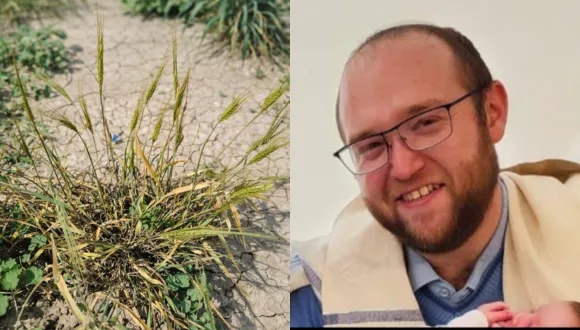
As our planet’s climate warms, how will we continue growing staple crops and feeding the global population? The answer may lie in our crops’ own ancestors. Researchers at Tel Aviv University’s School of Plant Sciences and Food Security have identified a genetic mechanism in a strain of ancient wild wheat that controls the size of wheat grains and nutrient distribution to seeds. The study was led by the late Dr. Zechariah Haber, who tragically fell fighting in Gaza before completing his PhD. His family accepted his doctorate on his behalf, and like his memory, his research lives on.
Wild wheat, one of the ancestors of modern wheat, grows wild in the Fertile Crescent and was once characterized by much greater genetic diversity than that of newer varieties. Because the processes of domestication and agriculture led to crop uniformity, much of the natural genetic variation was lost. Dr. Haber and his fellow researchers sought to examine whether the genes left in wild wheat could offer ways to improve its modern descendent.

Dr. Haber’s family accepted his degree on his behalf in a moving graduation ceremony. (Photo: Invision)
To this end, they analyzed about 460 wild wheat lines collected from various climatic zones in Israel, and compared their genetic characteristics with the grain weight, size, and nutrient composition. Separating one gene from the rest, the researchers used CRISPR technology to edit the gene and understand its role: when the gene’s activity was reduced, the wheat grains became larger and heavier, along with an increase in protein, iron and zinc.
“Wild wheat is an extraordinary genetic reservoir, built over thousands of years of evolution under changing environmental conditions.” – Dr. Nir Sade
The study also found that different versions of the gene have different geographical distributions: one is prevalent mainly in hot and dry areas, while the other is characterized by cooler and more humid areas. This suggests that the gene also played a role in the natural adaptation of wild wheat to different environmental conditions, and so may also be important in the development of varieties that can maintain yield and quality even in a changing climate. According to the researchers, wild wheat continues to serve as a natural “gene library” that can provide new tools for modern agriculture.
The study was led by the late Dr. Haber and postdoctoral students Dr. Devinder Sharma and Dr. Manes Prosti, all from Dr. Nir Sade’s lab at the School of Plant Sciences and Food Security and the Institute for Cereal Crops Research at the Wise Faculty of Life Sciences, in collaboration with researchers from the University of Haifa, the Agricultural Research Administration (Volcani Institute) and Ben-Gurion University. After Dr. Haber’s tragic passing, Dr. Sade’s lab continued his research, leading them to the discovery that could help address our planet’s increasing food demand and the challenges posed by climate change.

Dr. Nir Sade with one wheat strain he studies. (Photo: TAU)
Dr. Nir Sade concludes: “Wild wheat is an extraordinary genetic reservoir, built over thousands of years of evolution under changing environmental conditions. As climate change poses new challenges to global agriculture, the discovery of such genes could help develop varieties that will provide a higher quality yield even under challenging growing conditions.”